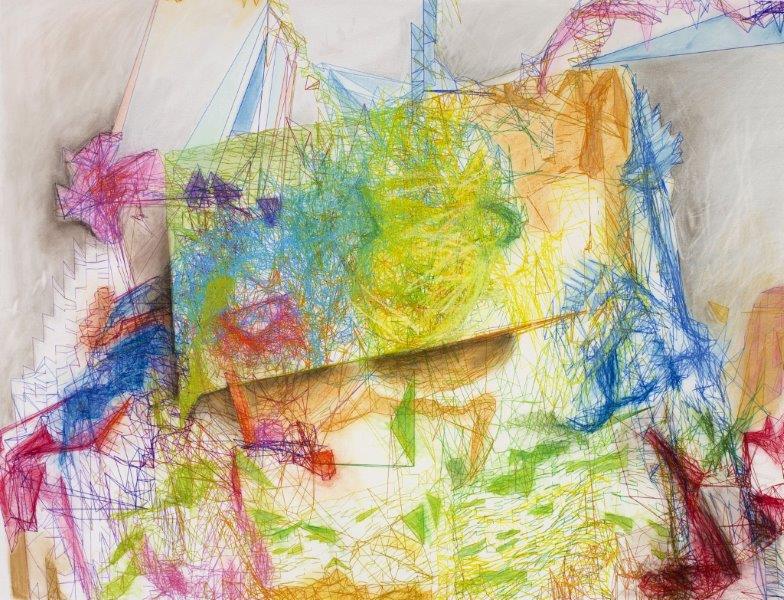
Susan Rosenberg, Hide n Seek at the Atelier, pastel, graphite, archival ink on paper, 112 x 82.5cms, 2013
For the British Computer Society column this month, it’s the annual end of year
special – a celebration of work submitted by readers of the column, BCS & Computer
Arts Society members. This demonstrates the wide variety of work being produced today with digital technology at its heart. Here is just one example, by Susan Rosenberg, fresh from her London exhibition. Read it here:http://www.bcs.org/content/conWebDoc/51769
8pm @ Richmond The American International University in London
Queen’s Road, Richmond-upon-Thames, Surrey, TW10 6JP
The inspiration for this talk comes from the great conceptual artist Sol LeWitt’s statement, The idea becomes a machine that makes the art (1967). Although LeWitt’s ‘machine’ was metaphorical rather than literal, nevertheless this radical concept raised questions about the notion of art process and creative behavior and challenged the notion of what art was or could be. To what extent does the hand of the artist need to be involved in the art-making? Artists such as David Hockney (on the iPad), Julian Opie, Jessica Steinkamp and others use computer code of simple instructions to generate complex and visually arresting art works. So why, more than 40 years after Le Witt’s comment, is it still such a leap of faith for some in the mainstream art world to conceive of the involvement of a machine like a computer? We will explore the use of computing and digital systems in art today.
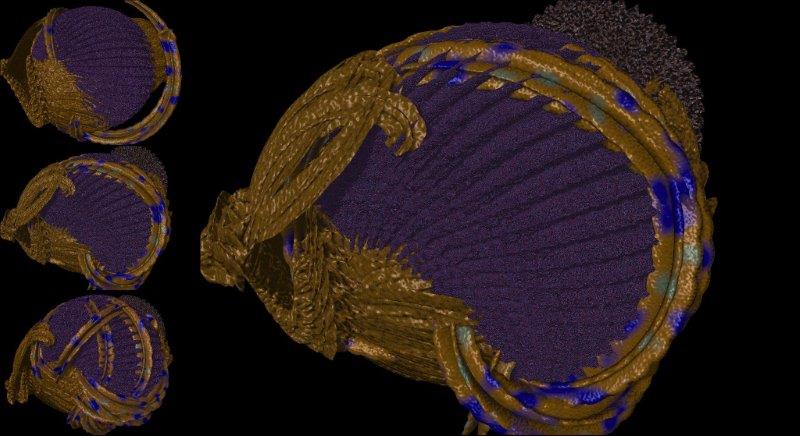
William Latham, Mutator 2 Evolving Form, 2013. Copyright the artist, reproduced with permission.
Bizarre, strange mutated forms looming out of computer space; William Latham is a gardener steering and evolving forms within a kind of virtual evolution. These images lead
us to imagine we are being allowed in on the secrets of the universe. Following on from his exhibition in Brighton, William is my BCS featured artist for the month of November: http://www.bcs.org/content/conWebDoc/51594
Grayson Perry said in his Reith Lecture this morning that if Michelangelo were alive today he wouldn’t be painting ceilings he’d be making CGI movies and 3D printing. He pointed out that artists have always been early adopters of new technology; it was an acknowledgement that perhaps the real innovation in art today is happening away from the traditional art world coterie of dealers/ galleries/auction houses and is engaging with technology or even taking place in cyberspace.
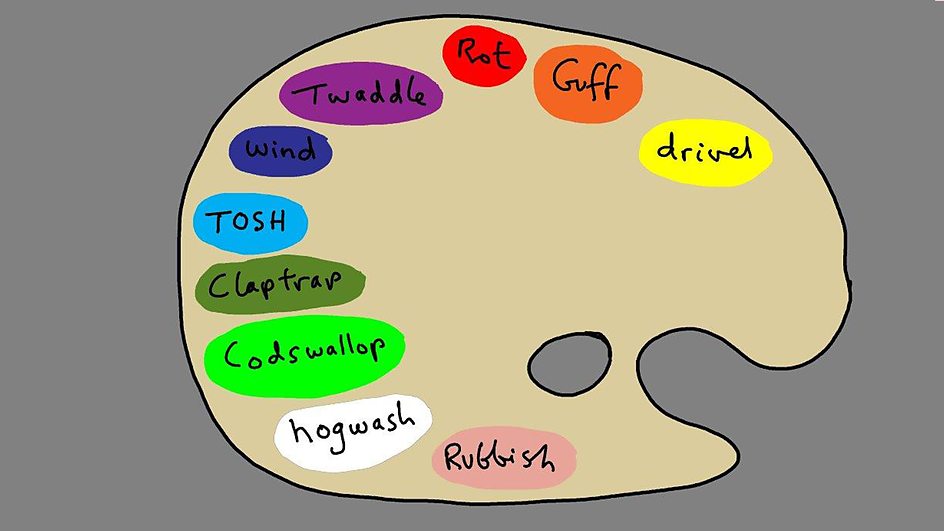
Grayson Perry (image from BBC Radio 4)
The 3 lectures so far have made for wonderful listening – I especially enjoyed hearing him take a strip off international art English (in first lecture) which is rife in the art world, spreading since the 1970s via the art press. Quoting artists Rule & Levine and their e-flux website language analyser – this type of art bollocks (sorry semantics) rebukes ordinary English for it’s lack of nouns. Perry said he gets metaphysical sea-sickness from reading this sort of text. There was a hilarious piece – an A to Z guide to fluent Artspeak, by Philip Hook, (whose new book about the art world is out this week), printed in this week’s Sunday Times Culture. My favourite Viewing Experience, Hook says is a nauseating term to denote looking at a picture in that it offers a highly engrossing viewing experience.
After today’s standing ovation at the lecture, I’d say Perry is seriously in danger of becoming one of Britain’s Greatest Living National Treasures.
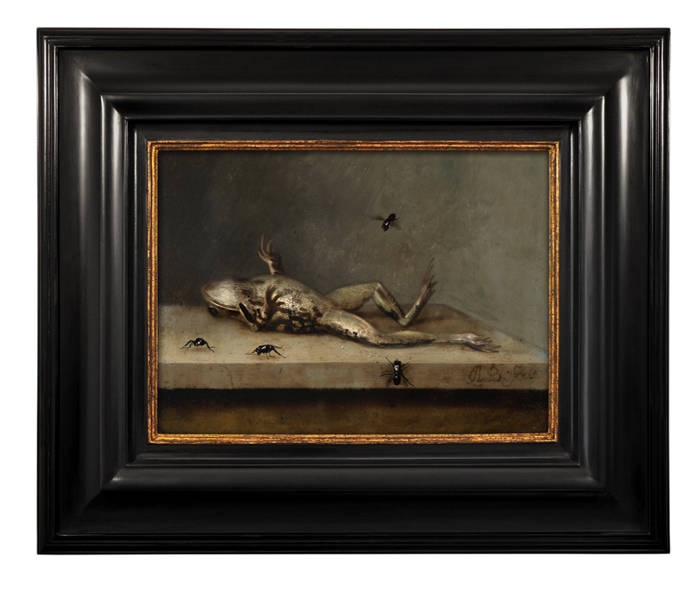
Rob and Nick Carter’s art is a memento mori with a twist, because what appears initially as a painted panel in a wooden frame (of the kind favoured by Dutch 17th-C
masters), upon sustained looking reveals a screen playing a looped animated image of a painted frog breathing its last and slowly decomposing before our eyes. An updated symbolic reminder of the inevitability of death for our digital age. Read more about Transforming Vanitas Painting, in my BCS article this month.
Rob and Nick Carter, Transforming Vanitas Painting, 2013 after Ambrosius Bosschaert the Younger, Dead Frog with Flies, c.1630, In collaboration with MPC. 3 hour looped film, frame & 21.5in Apple iMac, edition of 12 + 5 artists proofs. Rob and Nick Carter, Courtesy of The Fine Art Society and MPC
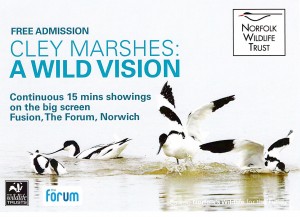
See me speaking about the history of landscape painting in North Norfolk in the new film Cley Marshes: A Wild Vision, produced by David North for the Norfolk Wildlife Trust’s Cley Marshes Appeal. If you are visiting Norwich in September, do pop in to the Forum to see this inspiring film featuring Bill Oddie, wildlife experts, artists and others sharing their stories of this special place.
The NWT is the oldest of a national network of wildlife trusts. The 400 acres of Cley Marshes were purchased by Dr Sydney Long in 1926. Long went on to found the Norfolk Wildlife Trust with Cley becoming the Trust’s first nature reserve. For generations this site has enjoyed a worldwide reputation as a superb site for watching birds and experiencing nature. The appeal is raising funds to purchase an additional 143 acres – this is a unique opportunity to ensure that coastal land from Blakeney Point to Kelling would all become one continuous nature reserve. Find out more about my landscape art project, Spirit of Place.
Nicola Costantino, Rapsodia inconclusa [Unfinished Rhapsody]: Eva el espejo [Eva the Mirror], detail of installation Argentina Pavilion: Eva – Argentina, 55th Venice Biennale 2013. Copyright the artist, reproduced with permission
Nicola Costantino’s, Rapsodia inconclusa [Unfinished Rhapsody], is an installation currently showing at the Argentina Pavilion of the Venice Biennale, which uses digital video to speak of the nation’s continuing attempts to make sense of a turbulent 20th-C political history. At the heart of this work is the controversial and emotionally-charged character of Eva Peron, the First Lady of Argentina from 1946 until her death in 1952. Read about Nicola Costantino’s work in my article this month for the BCS:http://www.bcs.org/content/conWebDoc/51225
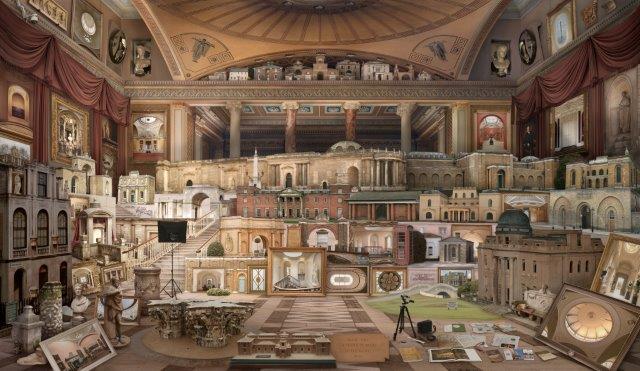
Emily Allchurch, Grand Tour: In Search of Soane (after Gandy), Transparency on LED lightbox, 106.6×182.4 cm, 2012. Copyright the artist, reproduced with permission
The UK artist and Royal College of Art graduate Emily Allchurch creates complex photographic images which draw on art history to make contemporary re-creations of iconic works. My image for the BCS this month is Grand Tour: In Search of Soane, an amazingly detailed and finely-crafted work currently on view at the Royal Academy of Arts Summer Exhibition (to 18 August). Read it here: http://www.bcs.org/content/conWebDoc/51058
Having recently returned from the art bun-fest that is the Venice Biennale, two main things strike me the quantity of surrealism on display and, as evidenced in the Russian and British pavilions, the importance of souvenirs.
I was pleasantly surprised by the selection on offer at the main exhibition hall in the Giardini from this year’s curator Massimiliano Gioni, which contained a large degree of outsider art to illustrate this year’s theme – The Encyclopedic Palace.
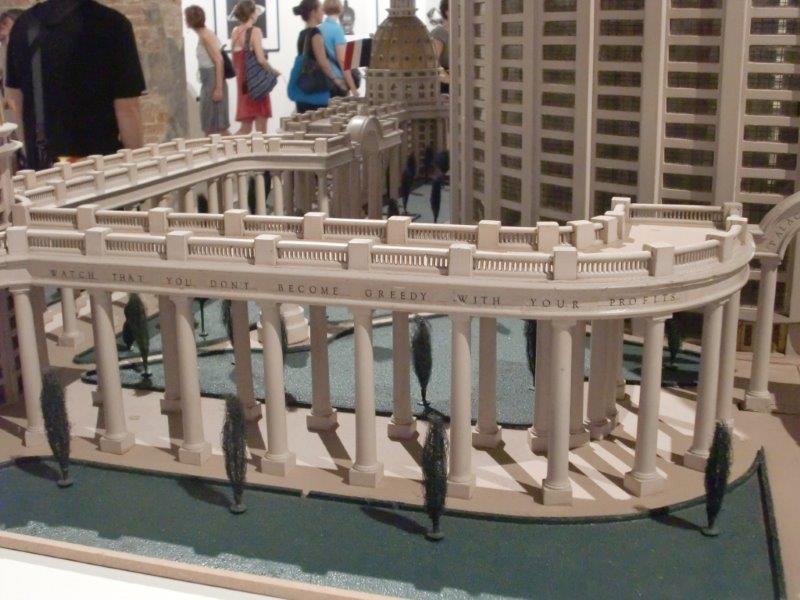
detail of Marino Auriti‘s model for The Encyclopedic Palace
The inspiration behind this being the work of Italo-American self-taught artist Marino Auriti who, in the 1950s, conceived of an imaginary museum that was meant to house all worldly knowledge, bringing together the greatest discoveries of the human race, from the wheel to the satellite. Sadly Auriti did not live to see the invention of the Internet & the World Wide Web, which his ideas seem to presage. His large model for the museum was exhibited in the Arsenale and contains quotes offering good advice written around the outside of the building, in letraset (Watch that you don’t become greedy with your profits is my favourite, see pic above).
Given the theme, it was a unfortunate that Massimiliano Gioni chose not to confront the reality of contemporary life by including art that addresses information and communications technology nor be informed by the increasingly virtual lives we now live on-line, through social networking, etc. The only piece with reference to this (and it was an historic one) was a video montage of work by Stan Vanderbeek at the end. Included within this were pioneering early computer-generated film clips, although from the explanatory panels the audience wouldn’t have known this. Apart from this failing, there were many things to admire here and new names to discover, much of it historic. I have had to rein myself in and show only a small selection.
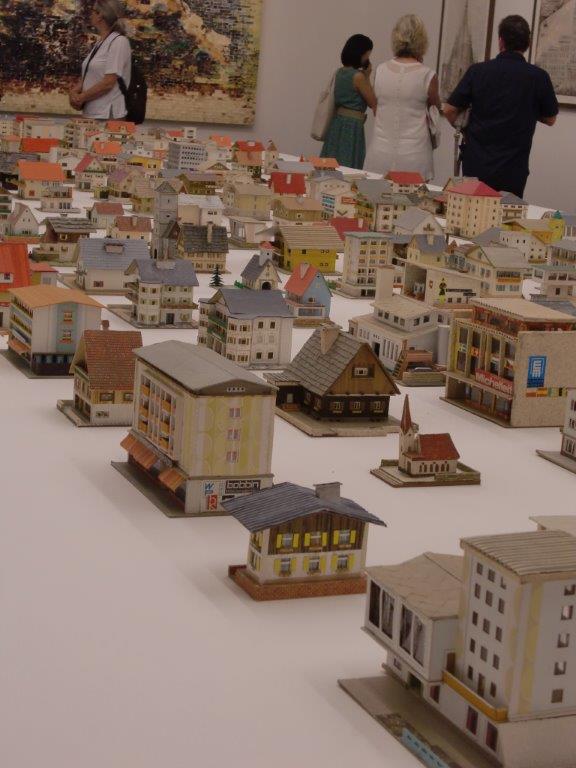
Oliver Croy and Oliver Elser, The 387 Houses of Peter Fritz (1916- 1992) Insurance Clerk from Vienna, 1993-2008 [detail]
On view was a selection of 176 models, from Oliver Croy and Oliver Elser, The 387 Houses of Peter Fritz (1916- 1992) Insurance Clerk from Vienna. These intricately detailed models of a wide variety of vernacular architecture were discovered wrapped in garbage bags in a junk shop by the artist Oliver Croy, presumably left there on the death of their creator Peter Fritz. Little is known of Fritz, but he must have spent years working on these constructions using cardboard, matchboxes, wallpaper, foil and other everyday materials.
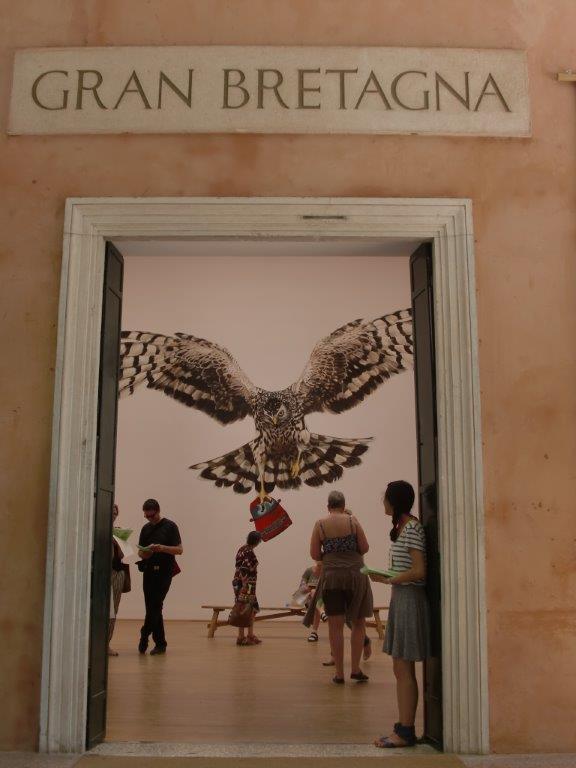
For the British pavilion, Jeremy Deller’s English Magic examined the notion of what Englishness might mean in the 21st-century by showing an eclectic variety of objects (and a film), some old (like ancient axe heads from the Museum of London), some made especially for this show and controversial, like the giant hawk and Range Rover mural (seen here), an ironic reference to an alleged incident of the shooting of a rare bird by Prince Harry (another work on this theme was pulled).
Jeremy Deller, entrance to the British Pavilion
It was clear that Deller is really more of a curator than a maker, but it was none the worse for that. He also served tea and gave visitors a chance to print (or at least rubber-stamp) their own souvenir. Various bags, posters, books and a vinyl record of the music of the Melodians Steel Orchestra from South London (featured in his film) were available to buy as souvenirs. This show will be coming to Turner Contemporary in Margate next year.
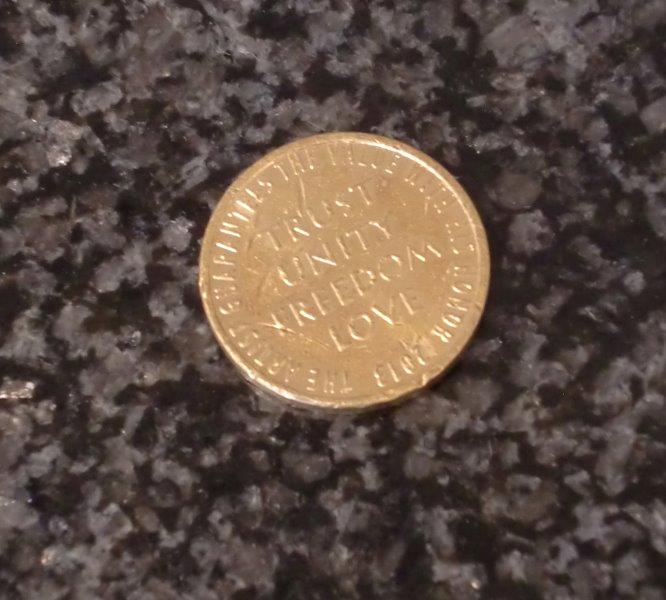
The Russians also produced a souvenir, but only women were allowed to collect it. The artist Vadim Zakharov focused on the ancient Greek myth of Dana , the mother of Perseus by Zeus. Thousands of specially made golden coins rained down in their pavilion (the falling shower of gold referencing the seduction of Dana as an allegory for human desire and greed, but also to the corrupting influence of money). Women visitors, equipped with umbrellas to protect from the torrent of metal coins, were encouraged to collect them up and deposit them in a shoot, thus recycling them back into the artwork. As such, we guarantee the flow of material goods as an ongoing process as the blurb put it.
my souvenir coin by Vadim Zakharov for Russian Pavilion
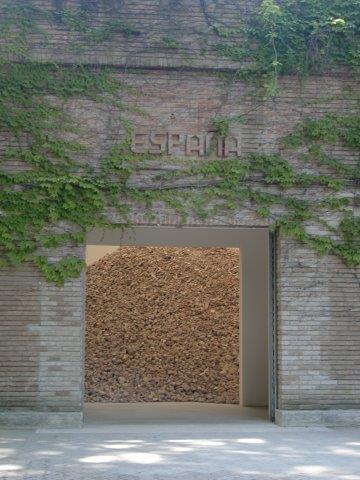
Gold might have been in abundance in Russia, but Spain showed their disgust with the current state of the economy by filling their pavilion almost entirely with a giant pile of rubble (and no doubt saving themselves money by not having to get special coins minted).
Spanish Pavilion
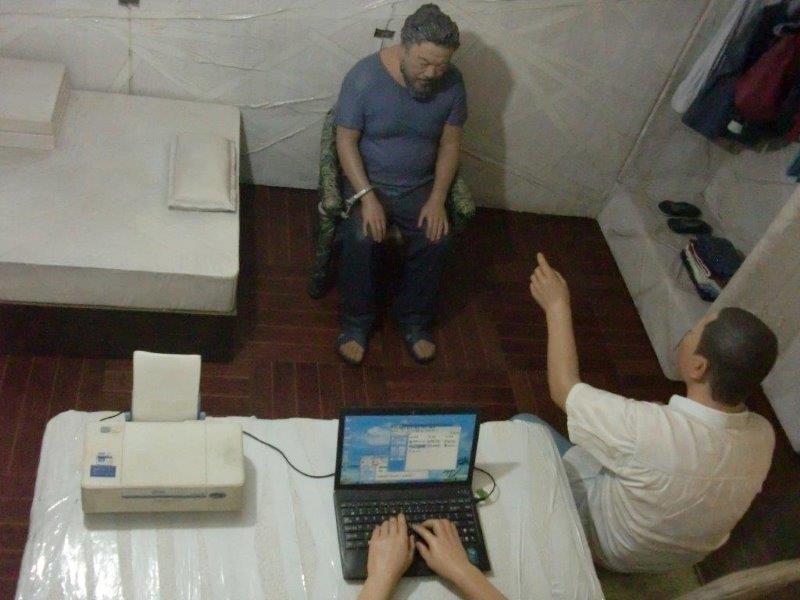
Among offsite projects, the highlight was famous Chinese artist Ai Weiwei’s S.A.C.R.E.D, located in the beautiful setting of Sant Antonin church. Six large, heavy, Donald Judd-like bronze containers filled the space dramatically; inside each one a tableau depicting Mr Ai’s 81 day incarceration at the hands of his government in 2011. The installation was reportedly built in Korea to the artist’s direction, as Mr Ai is currently being kept by force in Beijing. Yes, it was very literal, but it did serve to remind us of the importance of Ai Weiwei keeping his profile high therefore a spot at the Biennale was an absolute must for this dissident artist to protect himself from a Chinese government who is not sure quite what to do with him, but knows that the world is watching. Visitors to the show, looking through the peepholes in the boxes, acted as witnesses to crimes against the individual. It was not too difficult to draw parallels with The Stations of the Cross, a Catholic ritual where a prayer is said in front of icons depicting each act against Christ as he is led to his death. Let us hope that this does not prove a portent for Ai Weiwei.
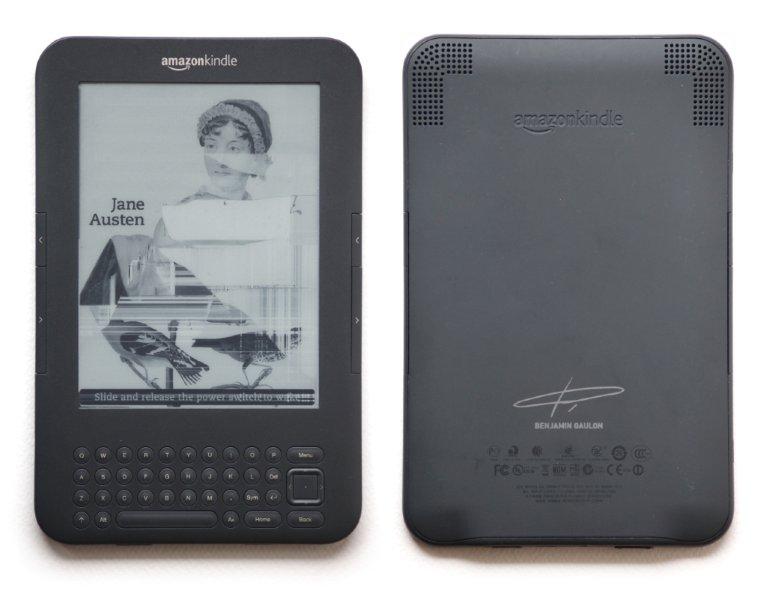
Have you ever heard of Glitch Art? Neither had I until Glitch Moment/ums the current exhibition at Furtherfield, which introduces this fascinating and varied aesthetic inspired by faults and malfunctions – the frustrating by-product of technology gone
awry.
Benjamin GaulonKindleGlitched, 2012. From a series of glitched Kindles donated, found or bought on eBay and signed by the artist. The generated visuals are unique and permanent. Glitch art subverts the way in which we are supposed to relate to technology, causing playful, imaginative disruptions. Copyright the artist, reproduced with permission
Benjamin Gaulon, our featured BCS artist this month, has a unique way of considering current information and communication technologies and teasing art from it. Learn more about Glitch Art and this artist here.

![Nicola Costantino, Rapsodia inconclusa [Unfinished Rhapsody]: Eva el espejo [Eva the Mirror], detail of installation Argentina Pavilion: Eva - Argentina, 55th Venice Biennale 2013. Copyright the artist, reproduced with permission.](http://www.catherinemason.co.uk/wp-content/uploads/2013/08/Eva-low-res.jpg)